Where to Stay in the Picos de Europa: Cangas de Onís, Arenas, Potes or Valdeón?
The best place to stay in the Picos de Europa depends on which side of the mountains you want to see, because no road crosses the massifs. For the Lakes of Covadonga, stay in Cangas de Onís. For the Cares route and Bulnes, stay in Arenas de Cabrales. For the Fuente Dé cable car and Santo Toribio, stay in Potes. For a quiet base in the middle of it all, stay in the Valdeón valley on the León side. If you have four days or more, split your stay between two of them rather than driving round the range every day.
This guide compares the main bases, what each is close to, how you get in and out without a car, and the special options: the two paradors, the high villages of Sotres and Bulnes, the campsites and the mountain refuges.
The short answer
| Base | Region | Best for | Character |
|---|---|---|---|
| Cangas de Onís | Asturias | Covadonga, the lakes | Busy small town, most services |
| Arenas de Cabrales | Asturias | Cares route, Bulnes, cheese caves | Village at a road junction |
| Potes | Cantabria | Fuente Dé, Santo Toribio, Liébana | Historic stone town |
| Posada de Valdeón | León | Southern Cares, quiet walks | Mountain valley village |
| Sotres | Asturias | Pandébano and the Naranjo | High, remote village |
| Fuente Dé | Cantabria | The cable car | A hotel at the foot of the cliff |
Why the base matters so much
The Picos de Europa are three limestone massifs ringed by valleys. The range is a roughly rectangular block about 20 km from north to south and about 35 km from west to east, but the roads go round, not across, and the mountain roads are slow. Moving from Cangas de Onís to Potes means looping through the valleys.
So the question is not “where is the centre?” but “which sights do I want, and in what order?” Our map guide shows how the sides fit together.
Cangas de Onís: for Covadonga and the lakes
Cangas de Onís stands at 87 m, on the north-west side of the range. The municipality of Cangas de Onís had 6,344 inhabitants in 2025, and the town is the largest base around the park, with the widest choice of hotels, apartments and restaurants.
Why stay here:
- The lakes bus starts here. Access to the Lakes of Covadonga is regulated in 2026 from 1 June to 18 October and on 24, 25 and 31 October, and buses leave Cangas de Onís bus station about every 15 minutes and reach the Buferrera car park beside Lake Enol in about 34 minutes.
- Covadonga is close. A shuttle runs every 30 minutes between Cangas de Onís and Covadonga from 7:40 to 19:00.
- History on the doorstep. The Battle of Covadonga took place in 722, and Cangas de Onís was capital of the Kingdom of Asturias until 774. The so-called Roman bridge at Cangas de Onís is actually medieval.
- Buses from Oviedo. The ALSA bus from Oviedo to Cangas de Onís takes about 1 hour 12 minutes over 76 km.
The downside is that Cangas is a long drive from Liébana, and in August it is busy. The park’s information office, Casa Dago, is in the town at Avenida Covadonga 43.
The Parador de Cangas de Onís
Just outside town is one of the most atmospheric places to stay in northern Spain. The Parador de Cangas de Onís occupies the Benedictine monastery of San Pedro de Villanueva, on the banks of the Sella. The parador is two kilometres from Cangas de Onís, and the building has been a National Monument since 1907.
Arenas de Cabrales: for the Cares and Bulnes
Arenas de Cabrales lies at about 140 m, on the northern edge of the central massif. Arenas de Cabrales is one of the main gateways to the Picos de Europa, and the parish of Arenas has 882 inhabitants.
Why stay here:
- The Cares route is close. From Arenas the AS-264 runs 6 km to Poncebos, the start of the Cares route and the Bulnes funicular.
- Leave the car. In 2026 the Arenas–Poncebos buses left Arenas from 8:15 to 13:00 and from 17:00 to 19:00, roughly every hour, and the bus from Arenas to Poncebos takes about 15 minutes.
- Sotres and Tielve too. Arenas to Tielve or Sotres costs €2.60 one way and €5 return, changing at Poncebos.
- Cheese. Cabrales cheese matures in natural caves, and the Cabrales Cheese Fair is held in Arenas de Cabrales on the last Sunday of August.
Arenas is smaller than Cangas, with fewer restaurants, but it is the obvious base if the Cares gorge is the main reason for your trip. Our Cares route guide covers the walk and the funicular.
Potes: for Liébana and Fuente Dé
Potes lies at 291 m, on the Cantabrian side, where four valleys meet. Potes has 1,323 inhabitants (INE 2025), and it is the most attractive town around the park: its historic quarter has been declared a Property of Cultural Interest, and the Torre del Infantado stands at its centre.
Why stay here:
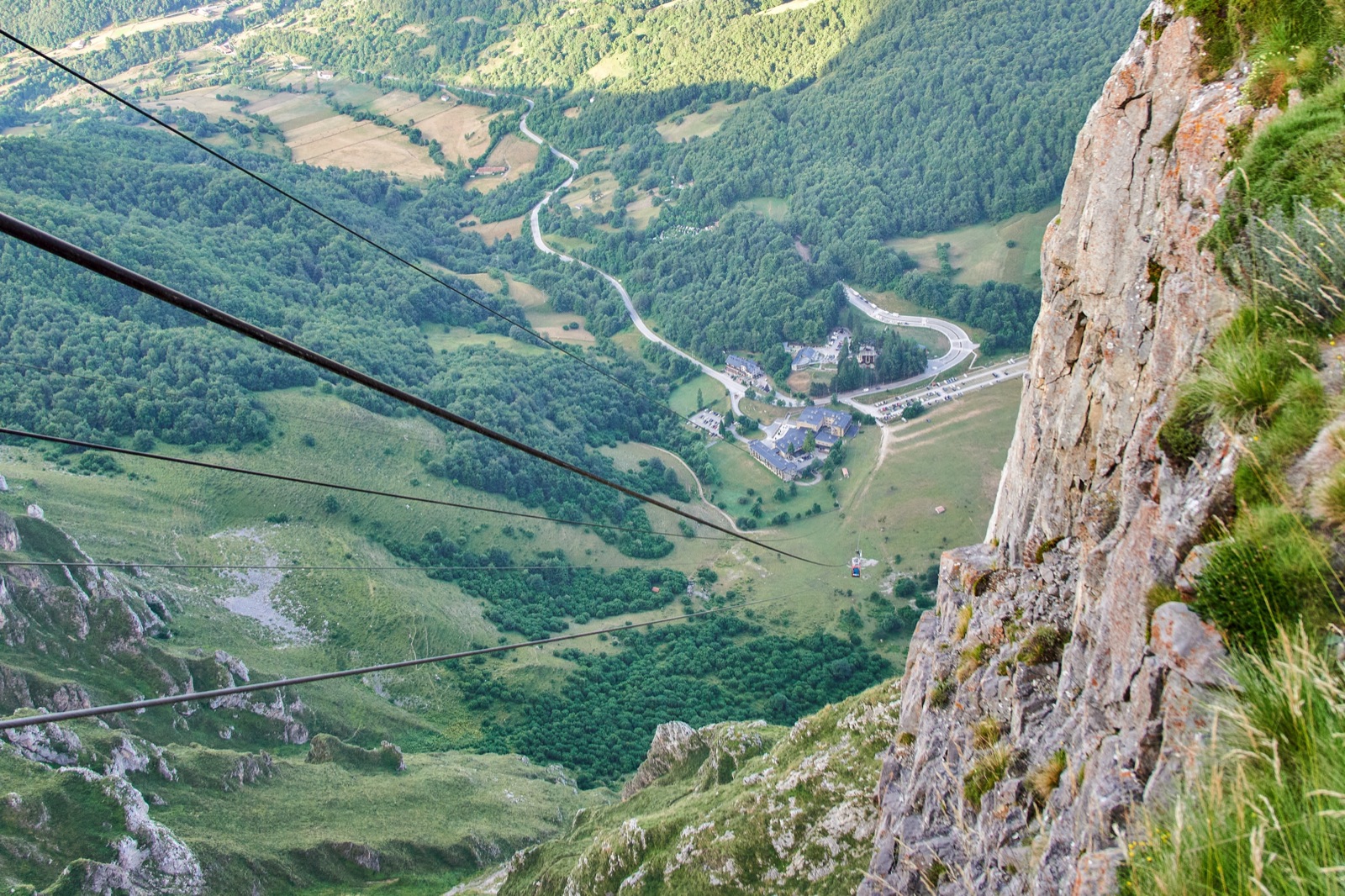
- Fuente Dé. The CA-185 regional road connects Potes and Fuente Dé, and the cable car at the end of the road climbs 753 m to 1,823 m in about 4 minutes.
- Santo Toribio. The monastery of Santo Toribio is in the municipality of Camaleño, near Potes.
- Better weather. Like the rest of Liébana, Potes has a Mediterranean-type microclimate that allows vines to be grown, and the vines give the local orujo.
- Monday market. Orujo and other products can be bought every Monday at a traditional market.
- Buses from Santander. The Cantabria transport portal’s page for Potes bus station lists Autobuses Palomera services to Santander.
The drive into Liébana from the coast runs through the Hermida gorge, almost 22 km long and carved by the river Deva. Potes is busy on the second weekend of November, when the Orujo Festival is held: in 2026 the Orujo Festival runs from 13 to 15 November.
Our Fuente Dé and Liébana guide covers the cable car, Santo Toribio and the walks.
Fuente Dé: sleeping by the cable car
Fuente Dé lies at 1,094 m, in the municipality of Camaleño. There is no village to speak of, but there is a parador. The Parador de Fuente Dé is a modern mountain lodge next to the cable car, and pets can stay at the Parador de Fuente Dé.
The advantage is simple: you are first in the queue when the cable car opens. From 14 September to 18 October the cable car runs 10:00–18:00 on weekdays and 9:00–18:00 at weekends. Note the winter closure: the Parador de Fuente Dé closes from 22 December 2026, and it stays closed until 23 February 2027.
Posada de Valdeón: the quiet heart
The León side is the least visited. The municipality of Posada de Valdeón has 392 inhabitants (INE 2025), and Posada de Valdeón (León) lies 100% inside the park. The Valdeón valley lies between the western and central massifs and is known as the heart of the Picos de Europa; the Cares runs through it from south to north.
Why stay here:
- The southern end of the Cares. Caín de Valdeón, the last village in the valley, is where the Cares route can be started on the León side.
- Viewpoints. The Mirador del Tombo, on the road from Cordiñanes to Caín, looks at the summits of the central massif.
- Park office. The park’s office in Posada de Valdeón has a short exhibition on the origin of the Picos, their flora and fauna.
Valdeón suits walkers who want quiet and do not mind a long drive to the Asturian sights. Camping El Cares at Santa Marina de Valdeón is the local campsite.
Sotres and Bulnes: the high villages
For a different kind of stay, two villages sit inside the mountains.
Sotres, at 1,050 m, is one of the highest villages in Asturias. Sotres has 109 inhabitants (INE 2023), and Sotres lies about 19 km from Carreña, the municipal capital of Cabrales. It is the base for the Pandébano col and the walk to the Naranjo de Bulnes: the Pandébano col is about 5 km from Sotres. Parking at Pandébano is tightly controlled, and in summer the Pandébano car park fills very quickly.
Bulnes has no road. You walk up or take the funicular from Poncebos: the funicular runs 2,227 m inside the mountain, climbing 402 m in about 7 minutes. Bulnes is in two parts: Bulnes de Arriba (Barrio del Castillo) and Bulnes de Abajo (La Villa). Staying the night means having the village almost to yourself once the day visitors leave.
Campsites
If you are travelling with a tent or a campervan, there are good campsites at each base: Camping Covadonga at Soto de Cangas, Camping Naranjo de Bulnes at Arenas de Cabrales, Camping La Isla and Camping La Viorna near Potes, and Camping El Cares in Valdeón. Wild camping is not allowed in the national park. Our camping guide compares them with prices and seasons.
Mountain refuges
For walkers, the most memorable nights in the Picos are in the refuges. Most refuges are guarded for part of the year, with food and bunks with blankets; when the guardian is away part stays open, and places should be booked in advance. Refuge places are booked through reservarefugios.com.
| Refuge | Massif | Notes |
|---|---|---|
| Vega de Ario | Western | 40 bunk beds, May to October |
| Vegarredonda | Western | 68 places, guarded all year |
| Vega de Urriellu | Central | 96 places, 15 March to 15 December |
| Áliva | Central | A refuge-hotel at 1,666 m with 70 places in rooms, May to September |
The Anillo de Picos guide explains how the refuges link into a multi-day route.
Getting to your base without a car
You can reach most bases by bus, though services are thinner in the mountains:
- Cangas de Onís from Oviedo by ALSA: the first bus leaves Oviedo at 06:30 and reaches Cangas de Onís at 08:05.
- Arenas de Cabrales by bus from Cangas de Onís and the coast, with the summer shuttle on to Poncebos.
- Potes from Santander by Palomera: at weekends the Santander–Potes buses (Palomera / Jiménez Movilidad) run at 9:30 and 17:30.
- Valdeón is the hardest without a car; check local services before you book.
Our guide on how to get to the Picos de Europa covers airports, buses and driving routes in detail.
Splitting your stay
With three or four nights, the classic split is two bases:
- Two nights in Cangas de Onís for the lakes and Covadonga, then
- Two nights in Potes for Fuente Dé and Santo Toribio, driving round through the Hermida gorge.
If the Cares route is your priority, swap Cangas for Arenas de Cabrales, or add a night there between the two. If you have a week, add Valdeón for the southern half of the Cares and the quiet valleys.
Food and evenings
Part of the pleasure of choosing a base is what you eat at the end of the day, and each side has its own tradition.
- Cabrales, around Arenas, is cheese country. Cabrales cheese is made by hand from raw cow’s milk or a mix of cow’s, sheep’s and goat’s milk, and it matures in caves in the mountains.
- Liébana, around Potes, is the land of stews and orujo. Local dishes include Liébana stew and game stews; orujo is the famous artisanal liquor. Cocido lebaniego is the typical chickpea stew of Liébana.
- Cangas de Onís has the most restaurants and the liveliest evenings, especially in summer.
Valdeón and Sotres are small, with a handful of places to eat; check opening times out of season.
With children or limited mobility
For families, Cangas de Onís and Potes are the easiest bases, with the most services and short, easy outings nearby. Easy there-and-back or circular walks around the lakes take under 2 hours, and the basilica and the Holy Cave at Covadonga open 8:00–20:00; entry is free and needs no booking.
For visitors with limited mobility, the lakes have an important exception: people with disabilities may drive up in their own vehicle, showing a disability certificate and ID. The cable car at Fuente Dé is also a way to reach the high mountains without a climb, though it closes on days of strong wind. The high villages, the Cares route and the refuges are not suitable for wheelchairs.
When to book
The busiest periods are Easter, the long weekends of May and the summer months, especially August. Many visitors come for the lakes in summer, when the bus quota matters: the transport plan carries at most 3,000 bus passengers a day, so buying in advance is recommended. Hotels in Cangas de Onís and Potes fill early on summer weekends, and the paradors book out first.
In autumn things quieten, but some of the mountain hotels and refuges close. Check the weather for each side on our weather page before you choose: the north-facing valleys and Liébana can be completely different on the same day.
Staying on a tour instead
If you are based on the coast in Gijón, Oviedo or Santander, a guided day trip can be simpler than moving hotels. The tours page lists day trips to the lakes and Cangas de Onís, to Bulnes with the funicular and a cheese cave, and to Liébana, Santo Toribio and Potes.
Frequently asked questions
Is Cangas de Onís or Potes the better base? Cangas de Onís for the lakes and Covadonga; Potes for Fuente Dé and Santo Toribio. They are on opposite sides of the range.
Where should I stay for the Cares route? Arenas de Cabrales for the Asturian end at Poncebos, or Posada de Valdeón for the León end at Caín.
Can I stay inside the national park? Yes, in villages such as Sotres, Bulnes and the Valdeón valley, at the Parador de Fuente Dé, or in a mountain refuge.
Is there a parador in the Picos de Europa? Two: the Parador de Cangas de Onís, in a Benedictine monastery, and the Parador de Fuente Dé, next to the cable car.
Do I need a car? It helps a great deal. Buses link Oviedo with Cangas de Onís and Santander with Potes, and summer shuttles serve the lakes and Poncebos.
When is the Parador de Fuente Dé closed? From 22 December 2026 until 23 February 2027.