Lakes of Covadonga: Access Rules, the Lakes Bus, Walks and the Holy Cave
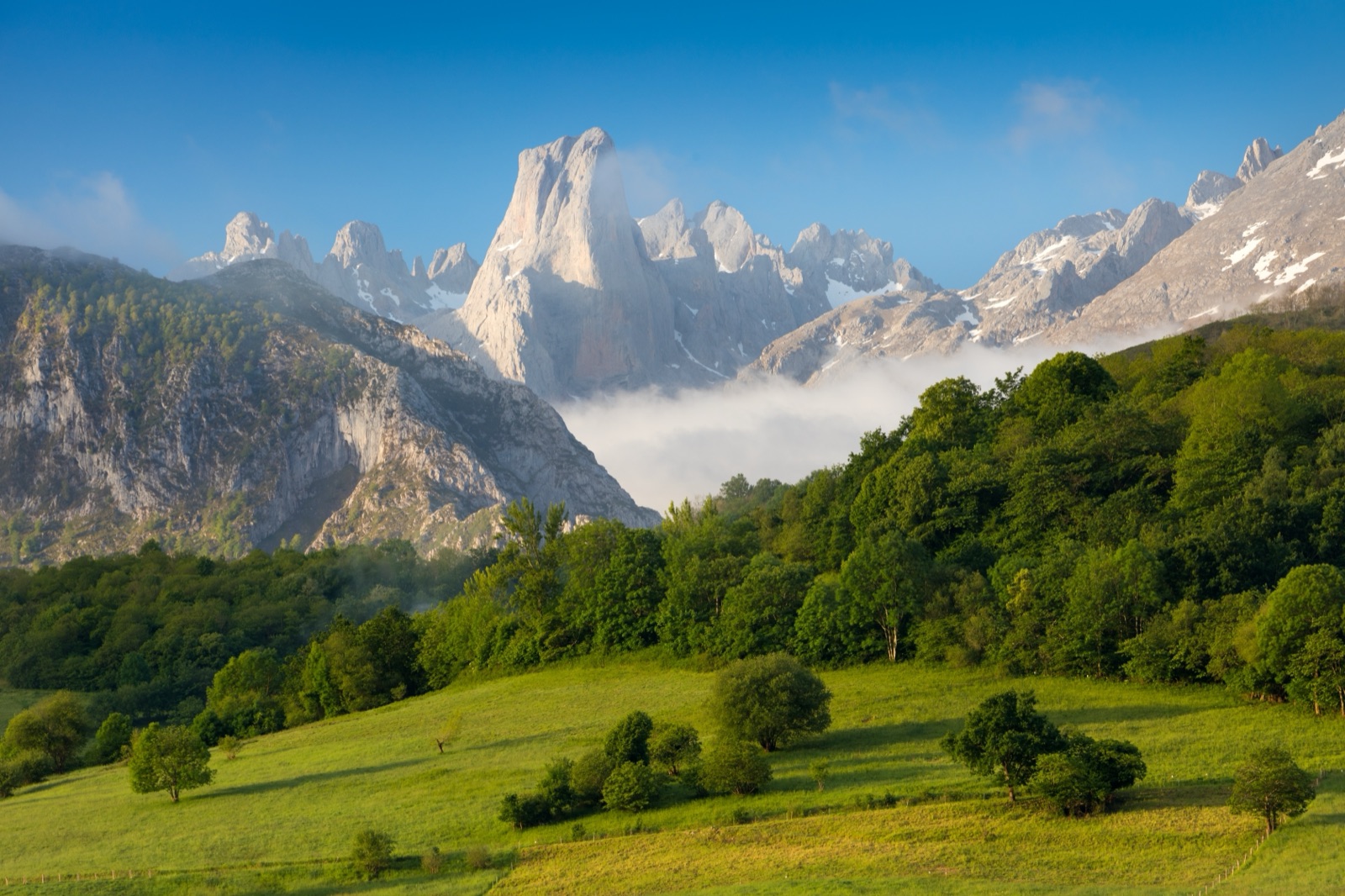
High above the sanctuary of Covadonga, at the end of a winding mountain road, two glacial lakes lie in a bowl of green pasture beneath the limestone peaks of the Picos de Europa. Cows graze on the shores, mist drifts across the water, and on clear days the mountains are reflected in the still surface. The Lakes of Covadonga are the most visited place in the national park, and the most carefully regulated.
This guide explains how to reach the lakes — which, for much of the year, means leaving the car behind and taking the lakes bus — what to see and where to walk once you are there, and how to combine them with the basilica and Holy Cave at Covadonga and the old royal town of Cangas de Onís.
The Picos de Europa at a glance
- The park descends from Spain’s first national park, the Montaña de Covadonga, declared by law on 24 July 1918.
- The national park covers 66,030.36 ha in Asturias, León and Cantabria.
- It has been a Biosphere Reserve since 2003.
- The Picos are the largest limestone formation in Atlantic Europe, with chasms more than 1,000 m deep and clear signs of glacial erosion.
- Chamois live on the crags, roe deer and wolves in the forests, with the occasional bear; more than 100 bird species include the black woodpecker, capercaillie, griffon vulture and golden eagle.
The lakes lie on the Asturian side of the park, in the western massif, above Covadonga and the town of Cangas de Onís.
The lakes
Where they are
Lakes Enol and Ercina lie at 1,070 and 1,108 m, reached from the sanctuary by a winding 12 km road. Halfway up the road is the Mirador de la Reina viewpoint, with wide views over the valleys. The lakes are glacial and fed by winter snowmelt.
There is also a third lake: there are three lakes, Enol, Ercina and Bricial, but Bricial only holds water during the thaw.
Lake Enol
Lake Enol, at about 1,070 m, is 750 m long, up to 400 m wide and up to 25 m deep. It is the first lake you reach and the larger of the two, with the bus terminus beside it.
Lake Ercina
Lake Ercina covers eight hectares at 1,108 m but is only three metres deep. Shallow and open, it often mirrors the peaks behind it, and it is the classic view of the lakes.
Getting there: the access rules
The lakes are so popular that private cars are banned from the road for much of the year. Understanding the rules is the key to planning a visit.
The road
The only road open to private vehicles to the lakes is the CO-4 from Covadonga; map apps may send you along tracks closed to private cars, which brings traffic fines. Ignore any app that suggests another route.
When cars are banned
- Access to the Lakes of Covadonga is regulated in 2026 from 1 June to 18 October and on 24, 25 and 31 October.
- In 2026 the lakes road is also closed to private cars on 28–31 March, 1–12 April (Holy Week), 18, 19 and 25–30 April, 1 May and May weekends, 1–2 November and 1–8 December.
- During regulation periods, private vehicles are excluded 24 hours a day, except vehicles with express permission.
Access to Covadonga itself is not cut, so you can always drive to the sanctuary; it is only the road above it to the lakes that closes.
When cars are allowed
On unrestricted dates, cars may go up until the lake car parks are full, when the road closes temporarily. Arrive early if you plan to drive on those days.
The lakes bus
During the regulation periods, the lakes bus from Cangas de Onís is the way up for most visitors.
The route
Buses leave Cangas de Onís bus station about every 15 minutes and reach the Buferrera car park beside Lake Enol in about 34 minutes, stopping at the El Bosque, Muñigo and El Repelao car parks. You can leave your car at the bus station or at one of the car parks along the way and board there.
Where to leave the car
- Cangas de Onís bus station. Cangas de Onís bus station, the start of the lakes buses, has a café-restaurant and parking for hundreds of cars, and is reached from the centre by a footbridge over the river Güeña. It is the simplest place to start, and every bus calls here.
- El Bosque. The El Bosque car park, 4 km out past Soto de Cangas, opens at Holy Week and in July and August.
- Muñigo. The Muñigo car park, very close to Covadonga, opens at Holy Week, in July and August and until 15 September; a footpath leads from it to Covadonga.
- El Repelao. El Repelao car park is open on all operating days, at the entrance to the national park and the sanctuary.
Timetable
- From 28 March to 30 September the first bus up to the lakes is at 8:00, the last up at 17:45 and the last down at 20:50.
- From 1 October to 8 December the first bus up is at 8:00, the last up at 16:00 and the last down at 19:05.
Tickets
- The transport plan carries at most 3,000 bus passengers a day, so buying in advance is recommended.
- Lakes bus tickets are sold online; if any remain, they can also be bought from the machines at Cangas de Onís bus station and other sale points.
Other ways up
- Taxi. Taxis to the lakes have no passenger limit.
- Bicycle. Bicycles can go up to the lakes at any time of year, for the strong-legged.
- With a disability. People with disabilities may drive up in their own vehicle, showing a disability certificate and ID.
- With pets. Pets may travel if there is a pet place on the bus or taxi, and must be on a lead in the park.
The Covadonga shuttle
If you only want the sanctuary, there is a separate shuttle: a shuttle runs every 30 minutes between Cangas de Onís and Covadonga from 7:40 to 19:00; a single costs €1.55.
At the lakes
The visitor centre
The Pedro Pidal visitor centre at Buferrera, by Lake Enol, gives information and, in the summer months, free guides for walks. It is the place to check conditions and pick up a route.
Easy walks
- Between the lakes. From Buferrera a path leads to Lake Ercina past the Buferrera mines and the visitor centre.
- Short loops. Easy there-and-back or circular walks around the lakes take under 2 hours.
- Longer walks. Walks from the lakes to Vega Redonda, Ario and the Ordiales viewpoint are of easy to moderate difficulty, for those with a full day and proper boots.
Weather and safety
- The weather at the lakes changes quickly, so bring warm clothes. Sun in the valley can mean fog and wind at the lakes.
- Springs outside the villages are classed as water without health control, so carry your own water.
- Plan walks, check the forecast and never walk alone, or leave word of your route.
- Flying drones in the national park is restricted to limited management use and permitted research, so leave the drone at home.
The shepherds’ festival
On 25 July the lakes host the Fiesta del Pastor, the shepherds’ festival, a traditional mountain gathering. Expect crowds and plan the bus well ahead.
Covadonga
The sanctuary
Below the lakes, in a narrow valley, stands the sanctuary of Covadonga: a pink basilica and, set into the cliff above a waterfall, the Holy Cave with its chapel. The basilica and the Holy Cave at Covadonga open 8:00–20:00; entry is free and needs no booking.
The history
Covadonga is at the heart of Spanish history. The Battle of Covadonga took place in 722, and Cangas de Onís was capital of the Kingdom of Asturias until 774. The Covadonga sanctuary holds the tomb of King Pelayo, the leader credited with the victory.
Getting there
El Repelao is the entrance to the national park and the Covadonga sanctuary; a footpath leads to the Holy Cave. It is one of the lakes-bus stops, so you can combine the sanctuary and the lakes on the same ticket day.
Cangas de Onís
Cangas de Onís, the gateway town, is worth an hour of its own. Its landmark is the high-arched bridge over the river Sella, although the so-called Roman bridge at Cangas de Onís is actually medieval, built under Alfonso XI of Castile in the 14th century on the site of a Roman one. The town’s bus station is the starting point for the lakes bus.
Tours to the lakes
If you are staying on the coast or in a city, a day tour handles the transport, the lakes bus and the timings.
Covadonga lakes from Gijón. A guided day to the glacial lakes of Covadonga, the basilica and holy cave, and Cangas de Onís, finishing on the coast at Lastres. About 11 hours, departing from Gijón.
Covadonga lakes from Santander or Llanes. The lakes, the basilica and the holy cave at Covadonga, and Cangas de Onís. About 9 hours, departing from Santander or Llanes.
The tours page lists them all with live prices.
A day at the lakes
- Early: park at Cangas de Onís bus station and take an early lakes bus; the first leaves at 8:00.
- Morning: from Buferrera, walk to Lake Ercina past the mines and the visitor centre, then loop back to Lake Enol.
- Midday: a picnic by the water, or a longer walk towards Vega Redonda or the Ordiales viewpoint if the weather is good.
- Afternoon: the bus down to El Repelao and the footpath to the Holy Cave and the basilica.
- Late afternoon: back to Cangas de Onís for the medieval bridge.
Choosing when to go
The regulation calendar shapes the whole visit, so it is worth choosing your dates with it in mind.
- In summer and early autumn, from 1 June to 18 October in 2026, the bus is the only way up for most visitors. The lakes are green and the walks open, but the bus fills up: book ahead, especially in August and around the shepherds’ festival on 25 July.
- In spring, the regulation covers Easter, some April dates and May weekends. On the days in between, you can drive up until the car parks fill, and the pastures are at their freshest.
- From late October, outside the listed dates, the road reopens to cars until the car parks fill, and the lakes are quiet. The bus still runs during the December holiday closure, with the last bus up at 16:00.
- At any time of year, the weather can turn quickly. Clear mornings often cloud over by the afternoon, so go early.
Beyond the lakes
The lakes are only one corner of a much larger park, and many visitors combine them with the other great sights of the Picos de Europa:
- The Cares gorge. A spectacular path through a limestone canyon between Poncebos and Caín. See our guide to the Cares route and Bulnes.
- Bulnes and the Naranjo de Bulnes. A mountain village reached by funicular, beneath the park’s most famous peak.
- Fuente Dé and Liébana. A cable car on the Cantabrian side that lifts you into the high mountains in minutes. See our guide to Fuente Dé, Potes and Santo Toribio.
Because the Picos are the largest limestone formation in Atlantic Europe, each side of the park has a different character: the green, pastoral lakes in the west, the deep gorges in the centre and the high rock walls around Fuente Dé.
What to bring
- Warm, waterproof layers, whatever the forecast in the valley.
- Walking shoes with grip; the paths are rough and can be muddy.
- Water and food, as springs are not tested and services are few.
- Your bus ticket, bought online in advance in high season.
- Binoculars for chamois on the crags and vultures overhead.
Practical tips
- Book the lakes bus in advance in summer; the daily limit is 3,000 passengers.
- Check the regulation dates for your day; they change every year.
- Ignore map apps that route you along closed tracks.
- Carry layers and a rain jacket, even in summer.
- Bring water and food; there are few services at the lakes.
- Go early for calm water, clear views and fewer people.
With children
The lakes suit families: the bus ride up is short, the walk between Enol and Ercina is easy, and there are cows, sheep and open space to run around. Keep children well away from the water’s edge, dress them warmly, and choose the short loops under 2 hours rather than the longer mountain walks.
Accessibility
During the regulation periods, visitors with disabilities can drive up with a certificate and ID. The area around the Buferrera car park and Lake Enol is relatively open, but the paths are unpaved mountain tracks. At Covadonga, the Holy Cave is reached by steps or a path from El Repelao.
Frequently asked questions
Can I drive to the Lakes of Covadonga?
Not during the regulation periods: in 2026, 1 June to 18 October and 24, 25 and 31 October, plus Easter, some spring dates and December holidays. On other days you can drive up until the car parks fill.
How do I get to the lakes without a car?
By the lakes bus from Cangas de Onís bus station, which reaches Buferrera beside Lake Enol in about 34 minutes. Buy tickets online; the daily limit is 3,000 passengers.
What time is the last bus?
From 28 March to 30 September, the last bus up is at 17:45 and the last down at 20:50. From 1 October to 8 December, the last up is at 16:00 and the last down at 19:05.
How high are the lakes?
Lake Enol lies at 1,070 m and Lake Ercina at 1,108 m.
Is the Holy Cave at Covadonga free?
Yes. The basilica and the Holy Cave open 8:00–20:00; entry is free and needs no booking.