Places
Potes, Cantabria: Old Town, Santo Toribio and the Road to Fuente Dé
Potes is the capital of Liébana, a compact stone town where the rivers Deva and Quiviesa meet, on the Cantabrian side of the Picos de Europa. It is where most visitors to this side of the mountains stop to eat, shop and sleep: the monastery of Santo Toribio, with its relic of the Cross, is close by, and the Fuente Dé cable car stands at the head of the valley, 22.7 km up the road.
Be clear about one thing: Potes is next to the Picos, not in them. The town lies at 291 m, in the valley, and it is not among the municipalities with land in the national park; neighbouring Camaleño, which includes both Santo Toribio and Fuente Dé, is. Potes is the base; the high mountains are a drive or a bus ride away.
Potes at a glance
- Where: the meeting point of four valleys, where the Quiviesa flows into the Deva, at 291 m.
- Size: 1,323 inhabitants (INE 2025).
- Protected: the old town has been a conjunto histórico since 1983, and Spain’s tourism board lists the historic quarter as a Property of Cultural Interest.
- Landmark: the Torre del Infantado, the tower in the middle of town.
- Market: every Monday.
- Festival: the Orujo Festival, on the second weekend of November (13 to 15 November in 2026).
- Nearby: Santo Toribio de Liébana, just outside town, and Fuente Dé, at the end of the CA-185.
A short history
Potes is first mentioned in 847, as Pautes. In the fourteenth century it was the domain of the Infante Tello, son of King Alfonso XI of Castile, and from 1445 it belonged to the Marquis of Santillana and his descendants, the Dukes of the Infantado. That family, the Mendozas, made Potes the capital of Liébana and built the great tower that still stands at its centre. The town’s first ordinances date from 1468.
Later centuries left their mark too. Many local people emigrated to the Americas, and wealth from the New World paid for some of the town’s notable houses.
The twentieth century was harder. During the Civil War, a fire on 31 August 1937 destroyed the historic centre, and the town was rebuilt after the war by the state’s reconstruction service for devastated areas, the Servicio Nacional de Regiones Devastadas y Reparaciones. Keep that in mind as you walk: much of the old-looking town you see today is that post-war rebuilding. The old town has been protected as a conjunto histórico since 1983.
The Torre del Infantado
The tower is the image of Potes. Our guide to Fuente Dé, Potes and Santo Toribio covers the basics: a medieval tower where the Deva and Quiviesa meet, reopened to the public on 19 March 2011 after a long restoration. There is more to it than the silhouette.
- Its history. Spain’s tourism board dates it to the fifteenth century. It belonged to the Dukes of the Infantado and has since served as a prison and, until recently, as the town hall.
- Inside. Its 1,800 square metres are spread over six floors around a central courtyard, and they tell the story of Beatus of Liébana, the monk whose works were created at Santo Toribio.
- The exhibition. It permanently houses Beato de Liébana y sus beatos, which Cantabria’s cultural centres network calls the most complete facsimile collection in the world of the illuminated manuscripts known as Beatus.
- The top. The visit ends on the battlements, with a view over Potes, the Viorna hill, the site of Santo Toribio and the Picos de Europa behind.
Opening times and tickets are handled by Cantabria’s cultural centres network, which sells tickets online; check before you go, as they change with the season.
Bridges, lanes and the old quarter
Potes is a town to walk slowly. Two rivers run through it, and much of the pleasure is in crossing and recrossing them.
- The bridges. The old bridges of San Cayetano and La Cárcel cross the Quiviesa, the Deva’s tributary, which joins the main river in the town.
- The quarters. Many of the town’s notable buildings are concentrated in the quarters of La Solana and El Sol.
- The Orejón de la Lama tower-house. One of several mansions and ancestral houses in the centre; Spain’s tourism board describes it as baroque, while other accounts place its origins in the same period as the Torre del Infantado.
- San Vicente. The parish church of San Vicente has building elements ranging from the fourteenth to the eighteenth century.
- Mount Arabedes. The 694 m hill that overlooks the town can be climbed from Potes, for the view back down over the rooftops.
Orujo, cocido and the Monday market
Orujo
Liébana’s great product is orujo, the local grape spirit. Like the rest of the valley, Potes enjoys a Mediterranean-type microclimate that allows vines to grow, and those vines give the orujo. Spain’s tourism board calls it the town’s famous artisanal liquor.
The Orujo Festival
The Orujo Festival, a Festivity of National Tourist Interest, was first held in 1984 and now takes place on the second weekend of November; in 2026 it runs from 13 to 15 November. Its centrepiece is a public distillation of orujo, which visitors then taste in the streets, alongside stalls of local food, music and traditional folklore. Also in November, Potes hosts one of the most important and crowded livestock fairs in Cantabria.
What to eat
- Cocido lebaniego. Liébana’s chickpea stew, the dish to order on a cold day.
- Game stews. Spain’s tourism board singles them out alongside the cocido.
- Borono. A kind of black pudding, served with apple.
- Cheese. Picón, the local blue cheese, appears on menus and market stalls. On the Asturian side, Cabrales plays the same role; see our guide to the Cares route and Bulnes.
The Monday market
Every Monday, Potes holds a traditional market with deep roots in the region, and it is the best place to buy orujo, cheese and other local produce. If your dates are flexible, plan a Monday in town.
Santo Toribio de Liébana
The monastery of Santo Toribio is in the municipality of Camaleño, near Potes, and you can see its site from the top of the Torre del Infantado. It keeps the Lignum Crucis, the largest known piece of the Cross, and it is counted with Jerusalem, Rome, Santiago de Compostela and Caravaca de la Cruz among the holy places of Christianity.
The monastery and its setting
The monastery stands at 410 m on the northern slope of the Sierra de la Viorna, above the valley, and today it is home to four Franciscan friars. Tradition credits Toribio, bishop of Astorga, with bringing the relic to Spain at the beginning of the fifth century. In the eighth century the monk Beatus of Liébana wrote and illustrated his books here, above all his Commentary on the Apocalypse, which is why the facsimiles in the Torre del Infantado belong to the same story.
Leave time for the surroundings. Near the monastery are the pre-Romanesque Cueva Santa, the ruins of the Santa Catalina sanctuary and two hermitages, San Juan de la Casería, from the sixteenth century, and San Miguel, from the thirteenth.
Visiting
The Diocese of Santander gives these times (check before you go, as they can change):
- Church and cloister: every day, 10:00–13:00 and 16:00–18:00.
- Lignum Crucis chapel: Monday to Saturday, 11:00–12:00 and 16:00–17:00.
- Pilgrims’ Mass: every day at 12:00.
- Entry: free, with no booking needed.
The chapel that holds the relic is Baroque, built at the beginning of the eighteenth century. On the south front, beside a buttress, is the Door of Forgiveness, which is opened solemnly for each Jubilee.
Jubilee years
A Jubilee Year begins whenever the saint’s feast day, 16 April, falls on a Sunday, and the Door of Forgiveness opens for pilgrims. The privilege goes back to a bull of Pope Julius II dated 23 September 1512.
- The last one. The 74th Jubilee Year began on 16 April 2023, following the previous one in 2017. By the time the door was closed again in April 2024 it had drawn more than 300,000 visitors and 16,000 pilgrims.
- The next one. The Door of Forgiveness will open again in 2028. Expect the monastery, Potes and the road between them to be much busier than usual that year.
More to know
- The monastery was declared a national monument on 11 August 1953.
- In 2015, when UNESCO extended the Camino de Santiago World Heritage listing, the monastery was included as part of the Camino de Liébana. Potes lies on that Camino Lebaniego, which links the coastal Way of St James with the Camino Francés.
- On 2 May, the Santuca festival carries an image of the Virgin in procession from Aniezo to Santo Toribio and back.
The road to Fuente Dé
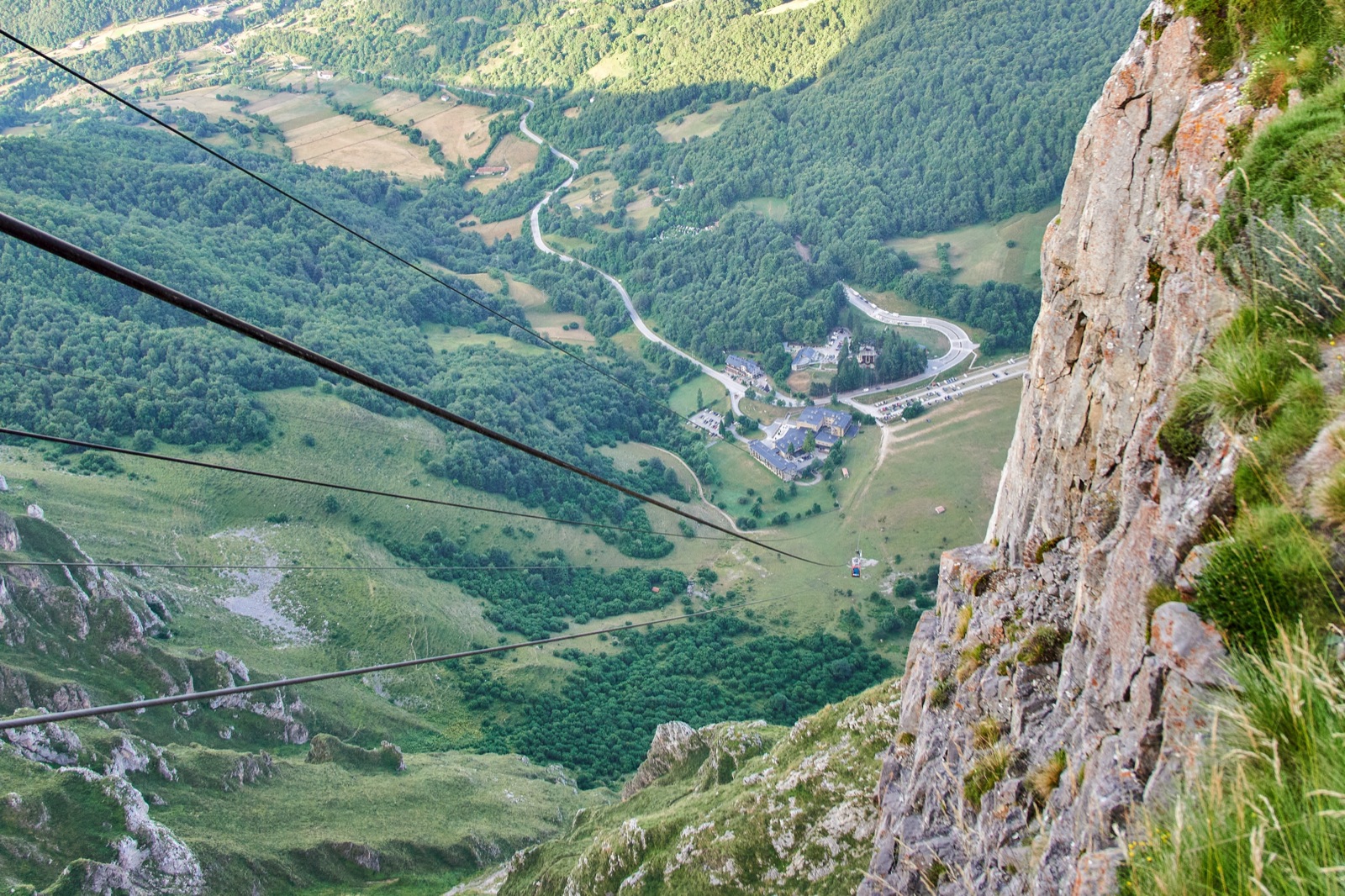
Fuente Dé is not in Potes: it is a separate place, at 1,094 m in the municipality of Camaleño, at the head of the valley. The CA-185 regional road connects the two. Measured as a cycling climb, the road from Potes to Fuente Dé is 22.7 km with 809 m of ascent, a steady rise up the valley rather than a mountain pass.
At the top, the cable car rises 753 m to 1,823 m in about 4 minutes. The weather decides the day there: the cable car closes on days of strong wind, as it did on 29 September 2026, and closures for safety or bad weather give no right to a refund. Check the operator’s notices before you drive up, and keep Potes and Santo Toribio as your plan B. Our Fuente Dé guide has the hours and prices.
Two ways to make it a walking day:
- Down from the top. The Puertos de Áliva route descends 14.5 km from the upper station to Fuente Dé; see our article on Picos de Europa hiking.
- Back to the monastery. The PR-S 7 path, the Camino de Valdebaró, runs 22 km from Fuente Dé to Santo Toribio de Liébana, a long day that ends close to Potes.
Liébana around Potes
Potes sits at the crossroads of the valley, and most of Liébana is within easy reach.
- Up the Camaleño valley. The CA-185 runs west to Fuente Dé. Espinama, near the top, is where the old track from the Puertos de Áliva comes down, 2.5 km below the cable car.
- Cosgaya. The Cantabrian village where the Ruta de la Reconquista, the long waymarked crossing of the Picos from Covadonga, comes to an end.
- Aniezo. The starting point of the Santuca procession to Santo Toribio each 2 May.
- The Hermida gorge. North of Potes, the road to the coast follows the Deva through the longest gorge in northern Spain.
Getting to Potes
- By road from the coast. The main approach is through the Hermida gorge, almost 22 km long and carved by the river Deva, the longest gorge in northern Spain. Allow time for the drive and for stops along the way.
- By bus. Cantabria’s public transport portal lists Autobuses Palomera services between Potes and Santander, and services linking Potes with Fuente Dé. Timetables change with the season and with school terms, so check the portal before you travel.
- On a tour. A day tour from Santander runs through the Hermida gorge to the monastery of Santo Toribio and the village of Potes, with an optional cable car ride into the mountains (about 9 hours). The tours page lists it with live prices, along with the full range of Picos de Europa tours.
- On foot. Pilgrims on the Camino Lebaniego arrive the old way, from the coast.
A day in Potes
- Morning: Santo Toribio first. The church opens at 10:00; aim to be in the chapel between 11:00 and 12:00, and stay for the pilgrims’ Mass at 12:00 if you wish.
- Lunch: back in Potes for cocido lebaniego.
- Afternoon: the Torre del Infantado and the view from its battlements, then the bridges and the lanes of La Solana and El Sol.
- Evening: a glass of orujo in town; on a Monday, plan the day around the market.
With a second day, drive up the CA-185 to Fuente Dé first thing, ride the cable car while the air is clear, and come back to Potes for a late lunch.
With children and accessibility
Potes is an easy town for families: short distances, rivers to watch from the bridges and plenty of places to stop. The Torre del Infantado is entered up a long flight of steps and through a pointed-arch doorway, which is worth knowing with a pushchair or for anyone who finds stairs hard; ask the cultural centres network about access before you go. The lanes of the old quarter have slopes and uneven stone in places. For a taste of the high mountains without a long walk, the Fuente Dé cable car is the easiest option in the valley.
When to go
- Monday, for the market.
- 2 May, for the Santuca procession to Santo Toribio.
- Summer, for long days and the best walking at Fuente Dé, but also the most visitors and the longest cable car queues.
- The second weekend of November, for the Orujo Festival (13 to 15 November in 2026), with the livestock fair in the same month.
- 2028, for the next Jubilee Year, if you want to see the Door of Forgiveness open and do not mind the crowds.
The valley is sheltered, but the mountains above it are not. Our article on Picos de Europa weather explains what to expect in each season.
Potes or Cangas de Onís?
They are the two classic bases, on opposite sides of the range. Potes is the base for Liébana, the south-eastern corner of the Picos: Fuente Dé, Santo Toribio and the Hermida gorge. Cangas de Onís, in Asturias, is the base for the western side: the Lakes of Covadonga and the sanctuary of Covadonga, covered in our lakes guide. If you have a week, split it between the two.
Frequently asked questions
Is Potes in the Picos de Europa national park?
No. Potes is the valley town at the foot of the Cantabrian side of the range, at 291 m. Its neighbouring municipality of Camaleño, which includes Santo Toribio and Fuente Dé, lies partly inside the park.
How far is Potes from Fuente Dé?
About 22.7 km by the CA-185, climbing 809 m up the valley. The cable car at Fuente Dé then rises 753 m to 1,823 m.
What day is the market in Potes?
Monday. The traditional Monday market is the place to buy orujo, cheese and other produce from Liébana.
When is the Orujo Festival in Potes?
On the second weekend of November; in 2026 it runs from 13 to 15 November. It was first held in 1984 and is a Festivity of National Tourist Interest.
When is the next Jubilee Year at Santo Toribio?
- A Jubilee Year begins whenever 16 April, the feast of Santo Toribio, falls on a Sunday, and the Door of Forgiveness opens for pilgrims.
Can you get to Potes by bus?
Yes. Autobuses Palomera runs services between Santander and Potes, listed on Cantabria’s public transport portal. Check the timetable before you travel, as it changes with the season.